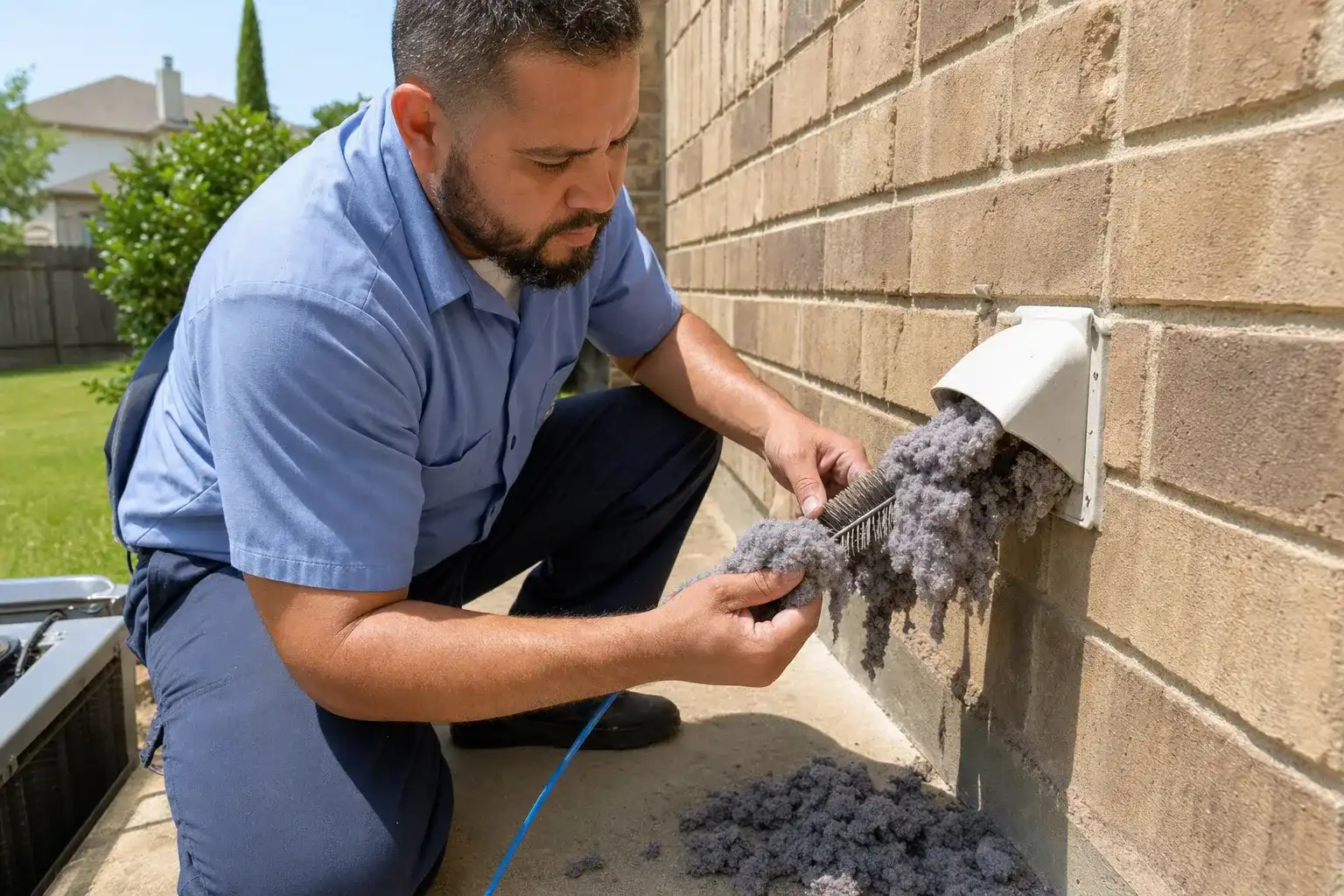
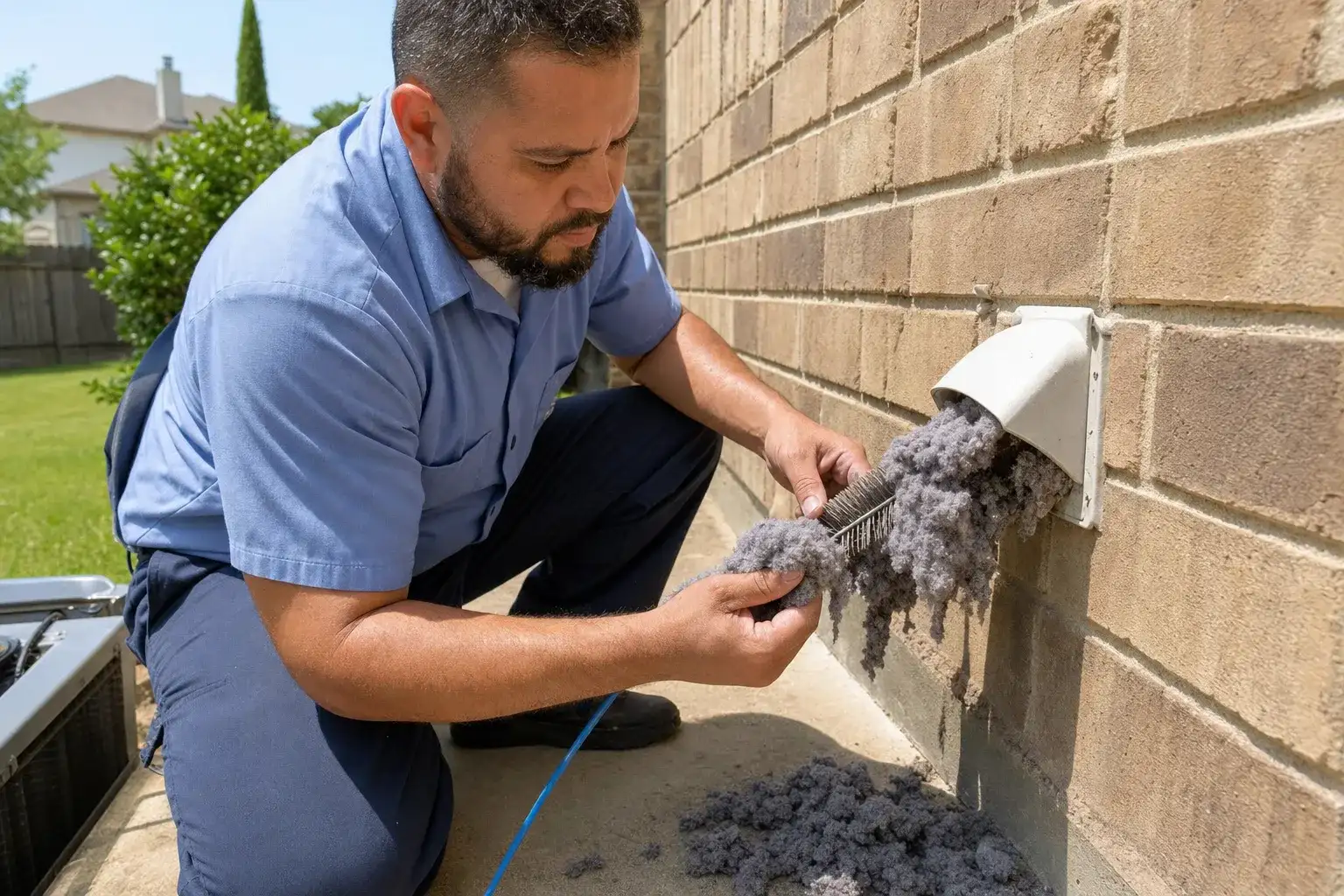
Why a Clogged Vent Makes a Dryer Run Twice
A dryer does two jobs at once. It heats the air, and it pushes the wet air out through the vent. Both have to work. If the vent is blocked, the hot, wet air has nowhere to go. It stays in the drum, the clothes stay damp, and the dryer keeps running until the timer or the moisture sensor gives up.
That is why a clogged vent looks like a heating problem. The dryer feels hot, but the clothes are not drying. Many homeowners replace the heating element and get the same result.
Lint is the usual cause. Every load sheds a little lint that gets past the screen. Over a year it builds a felt-like layer inside the pipe. The longer the run and the more elbows it has, the faster it clogs.
A 10-Minute Check You Can Do at Home
Do this on a day when the dryer is running a normal load.
- Clean the lint screen. Pull it out, clear it, and hold it under the faucet. If water pools on top instead of running through, fabric softener has coated the screen. Wash it with dish soap.
- Feel the top of the dryer. After 20 minutes, the top should be warm, not hot. A hot top means heat is trapped.
- Check the laundry room. If the room is warm and humid, wet air is leaking into the room instead of leaving through the vent.
- Go outside to the cap. With the dryer running, find the cap on the wall or roof. The flap should be open and you should feel a steady, warm push of air. Weak air or a closed flap means a blockage.
- Look behind the dryer. Pull it out a few inches. If the hose is crushed, kinked, or is the thin foil or white plastic kind, it is choking the airflow.
- Sniff for a burning smell. A faint hot-lint smell near the dryer is lint cooking on the heater.
If steps 2, 3 or 4 fail, the vent is the problem. If the hose in step 5 is crushed or torn, that is a repair, not just a cleaning.
Other Causes to Rule Out
The vent is the first suspect, but not the only one. Use this table to sort it out.
| What you notice | Likely cause |
|---|---|
| No heat at all, drum spins | Heating element, thermal fuse or gas valve |
| Hot dryer, damp clothes, weak air at cap | Clogged vent |
| Dryer shuts off early | Overheat switch tripping because the vent is blocked |
| Damp clothes, strong air at cap | Overloaded drum, wet washer spin, or a bad moisture sensor |
| Loud squeal or thump | Drum roller or belt, not the vent |
| Slow drying only on one cycle setting | Timer or control board |
Most dryers have a safety switch that cuts the heater when the air inside gets too hot. A blocked vent trips it over and over. Clear the vent and the heater often comes back on. If not, the thermal fuse may have blown and needs an appliance tech.
What a Slow Dryer Costs You
A dryer that runs twice uses twice the power or gas every month. It also wears the heating element, the motor and the belt twice as fast, so the dryer dies years early.
The bigger cost is fire risk. The U.S. Fire Administration estimates that fire departments responded to about 2,900 clothes dryer fires in residential buildings each year from 2008 to 2010, with an annual average of 5 deaths, 100 injuries and $35 million in property loss. The agency lists failure to clean as the leading factor in dryer fires. Its statistical reports on fire causes are public on its website. Keeping the vent clear removes the fuel.
Why Highland Village Dryers Clog Faster
Most homes in Highland Village were built between the 1980s and the 2000s with the laundry room in the middle of the house. The vent cannot go straight out a wall. It climbs through the attic to a roof cap, often 20 to 30 feet with two or three elbows. We see these long runs across Highland Shores, Chapel Hill and Briarhill Estates.
The attic makes it worse. North Texas attics pass 130 degrees in summer. Dryer air is warm and wet, so lint sticks to the hot pipe walls instead of blowing through. Damp air off Lewisville Lake adds to it. Lint that absorbs moisture clumps and packs tight.
Older homes here also tend to have the original foil hose behind the dryer. That hose sags, traps lint in every ridge, and tears when the dryer is pushed back. If yours is foil or white plastic, replace it with smooth metal, or have it done as part of a dryer vent repair.
When to Call for Dryer Vent Cleaning
If your home check shows weak air at the cap, a hot dryer and damp clothes, book a dryer vent cleaning in Highland Village. A full cleaning runs a rotating brush through the entire line while a vacuum pulls the lint out, from the dryer connection to the roof or wall cap. A home kit cannot reach a 30-foot attic run with elbows, and brushing the wrong way packs the lint tighter.
Cooper’s Air Duct Cleaning cleans dryer vents in Highland Village, Flower Mound, Lewisville and the towns around the lake. Every job comes with a written price before we start and before-and-after photos of the vent when we finish. If we find a crushed hose, a vent that ends in the attic, or a cap with a mesh screen, we tell you and price the repair separately so you can decide.
Many homeowners book the dryer vent along with air duct cleaning for the whole house, since we are already on site with the vacuum and brushes. For the dryer vent on its own, the vent cleaning service page covers what is included and how often to do it. Either way, it is one visit from one air duct cleaning company in Highland Village.
Get a Free Quote
Tired of running every load twice? Call or send the form. We will check the vent, give you a written price before any work starts, and send before-and-after photos when the line is clear. We answer 7 days a week and serve Highland Village, Flower Mound, Lewisville, Lantana, Double Oak, Copper Canyon, Bartonville, Argyle, Corinth, Lake Dallas, Hickory Creek and Denton.